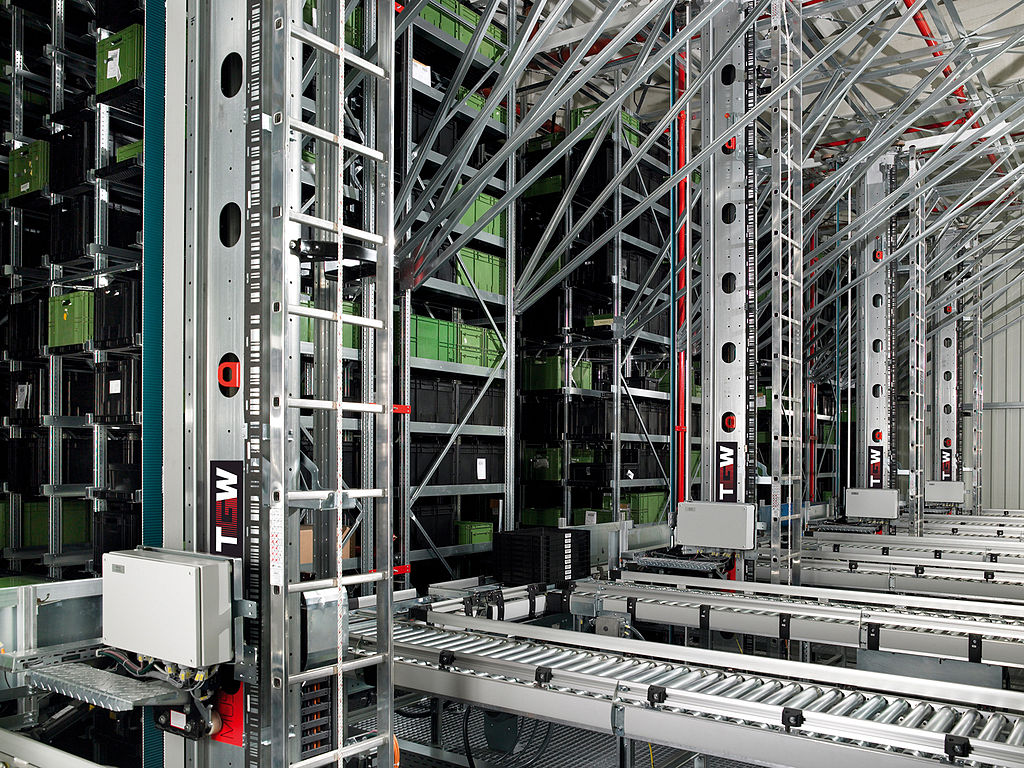
The world of automated storage and retrieval systems (AS/RS) has changed dramatically in recent years to keep pace with technology and supply chains. Today’s AS/RS includes shuttles, autonomous mobile robots (AMRs), cube-based designs, carousels and hybrid approaches, among many others, to bring more flexible, scalable and efficient solutions.
AS/RS systems help manufacturers, distributors and logistics providers to maximize space and improve efficiencies. Think increased throughput, reduced labor, improved order accuracy, SKU accessibility and other benefits like improved safety.
AS/RS systems are a cornerstone of the goods-to-person order fulfillment strategy. In traditional person-to-goods (GTP) fulfillment, operators spend up to 70% of their time walking to and from storage locations to pick items. GTP reverses this to bring the required goods directly to a fixed, ergonomic workstation.
Key categories of AS/RS
The most common and widely deployed types of systems are unit-load (pallet) AS/RS, mini-load AS/RS (stacker-crane systems for cases/totes), shuttle-based systems (multi- or single-shuttle grids), vertical lift modules (VLMs), horizontal and vertical carousels and GTP robotic grid systems (such as small robots that retrieve bins vertically and horizontally).
Unit-load systems are designed for handling palletized or bulk goods, such as pallets or large containers, using stacker cranes that travel horizontally and vertically to store and retrieve loads. These installations dominate total installed capacity due to their need for pallet handling in manufacturing, and food and beverage logistics.
Often used in light manufacturing and retail settings, mini-load systems (for smaller items stored in totes or cartons), VLMs (offering high vertical storage) and carousels bring efficiencies and limited scalability, typically for up to only moderate SKU counts. These AS/RS systems are classic GTP tools.
Shuttle-based (robotic rail shuttles that travel horizontally on each storage level) and robotic grid systems (using stacked bins within a storage cube, sometimes known as cube-based systems), such as AutoStore solutions, are among the fastest-growing segments. Both of these systems work well with high SKU counts and high throughput where space is at a premium and incremental scaling is needed. Growth of these systems has been driven by complex e-commerce and omnichannel retail supply chains, SKU proliferation and labor shortages.
Additional emerging types of AS/RS include deep-lane pallet shuttle systems (combine shuttle and crane technology), AMRs (autonomous mobile robots), and gantry-based solutions. These categories reflect the evolving AS/RS landscape, where modularity, flexibility and robotic mobility are driving rapid growth.
Deep-lane shuttle systems act as a hybrid of traditional unit-load systems and shuttle technology. These systems enable high-density pallet storage; especially well-suited for high-throughput or cold storage operations.
AMRs are a great example of flexible GTP workflows where autonomous mobile robots transport pods or bins to pick stations, making them attractive for e-commerce and fast-scaling operations.
Overhead gantry-based robotic systems are also emerging, particularly for non-standard or larger loads, and are increasingly paired with AI-enabled vision technology.
Together, these systems represent the evolving AS/RS ecosystem that emphasizes modularity, flexibility and robotic mobility to meet the growing demands of modern, high-velocity warehouses.
Now with AI
Like many other industries, AI generally is generally transforming warehouses. Likewise, AI is a contributor to the renovation underway in AS/RS systems, enabling real-time data analytics, predictive maintenance on material handling equipment and dynamic decision-making. Machine learning and AI algorithms can now optimize storage layouts to do things like place high-demand SKUs in accessible locations, according to MarketsandMarkets.
AI is often used to enable real-time prioritization of tasks—like adjusting retrieval sequences based on shipping deadlines—to reduce bottlenecks and streamline workflows. AI also improves order-picking accuracy through integration with vision systems and robotics, minimizing errors and boosting fulfillment precision.
AI is already transforming e-commerce and retail supply chains by supporting space efficiency with retrofittable solutions for faster order processing. One example of this, reports Coherent Market Insights, is AI-powered modular AS/RS by Instock Inc. (backed by Amazon) which uses AMRs that can even navigate walls and ceilings—not just floors—to pick up storage bins and return them to pick stations with high efficiency.
Putting AS/RS to work
AS/RS technology has come a long way to encompass a wide span of warehouse automation that brings flexibility and scalability to an operation with future-ready technology. With advances in AI, robotics and modular design, these systems are transforming how storage and retrieval are managed today while shaping the automated facilities of the future.
In sum, AS/RS offers a range of strategic and operational benefits that go beyond simply automating inventory movement. At their core, these systems increase efficiencies, accuracy and space utilization which can equate to major cost savings and improved service levels for warehouses and distribution centers. The trick is keeping AS/RS versatile and adaptable enough to meet evolving operational demands.